How Much Does a False Ceiling Cost? Complete Price Guide

The ultimate guide to false ceiling costs in India. Compare gypsum, POP, PVC, wood, and glass options. Includes material prices (₹40-₹600 per sq ft), installation charges, city-wise rates, and a cost calculator.
⚡ Quick Summary: False Ceiling Costs 2026 |
|
Understanding False Ceiling Costs in 2026
Imagine entering a room that feels more inviting, stylish, and comfortable. That’s the magic of false ceilings! Not only do they elevate the aesthetics of any space, but they also offer practical benefits like sound insulation and temperature control. However, if you're considering this upgrade for your home, you might find yourself asking an important question: “How much are false ceiling charges?”
Don’t worry; you’re not alone! Many homeowners share this curiosity. This blog will dive into everything you need to know about false ceiling charges. We'll guide you through the essentials, from the factors that influence pricing to the materials available. So, let’s get started on this journey to transform your home with a stunning false ceiling!
💡 2026 Reality: False ceiling costs have stabilized after the pandemic-era price fluctuations. Material costs are now more predictable, making budgeting easier. For a typical 10x10 ft (100 sq ft) room, expect to spend ₹7,500-₹60,000 depending on material choice and design complexity.
Key Factors Determining False Ceiling Costs
Factor | Impact on Cost | Typical Range |
|---|---|---|
Material Choice | Primary cost driver (40-60% of total) | ₹40-₹600 per sq ft |
Design Complexity | Labor intensity affects pricing | +20-40% for intricate designs |
Room Size | Larger areas may get volume discounts | 5-10% discount >500 sq ft |
Labor Charges | Varies by city and expertise | ₹30-₹80 per sq ft |
Ceiling Height | Higher ceilings need more material | +10-15% above 12 feet |
Location/City | Metro cities cost 20-30% more | Varies significantly |
Additional Features | Lighting, patterns, borders | +₹50-₹200 per sq ft |
Types of False Ceiling and Their Cost

There are various options available for false ceilings, each with unique cost implications. Let’s break it down in a way that makes sense for your home and budget!
1. PVC False Ceiling

₹40-₹60 per sq ft Most Economical
Material Cost: ₹40-₹60 per sq ft (including installation)
10x10 Room Cost: ₹4,000-₹6,000
What It Is: Lightweight plastic panels that clip or screw into a metal framework. Available in various colors, finishes, and patterns.
✅ Advantages
Most affordable option
Completely waterproof and moisture-resistant
Easy and quick installation (1-2 days)
Low maintenance
Termite-proof
Easy to clean with a damp cloth
Perfect for bathrooms and kitchens
❌ Disadvantages
Less premium aesthetic
Limited design flexibility
Visible panel joints
Can sag over time in large spans
Not suitable for high-end interiors
Lower resale value impact
Best For: Budget-conscious homeowners, rental properties, bathrooms, kitchens, basements, commercial spaces
2. Gypsum False Ceiling
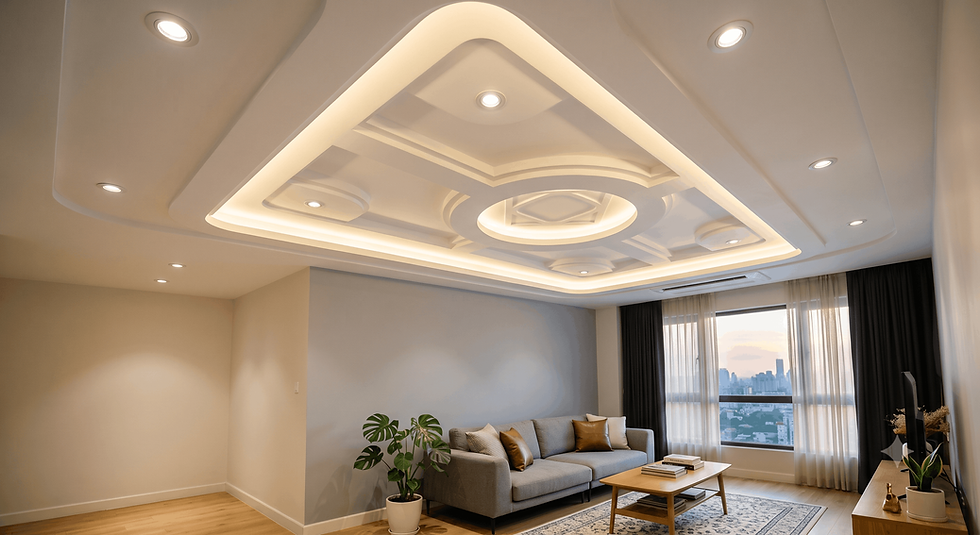
₹75-₹120 per sq ft Most Popular
Material Cost: ₹75-₹120 per sq ft (including installation)
10x10 Room Cost: ₹7,500-₹12,000
What It Is: Gypsum boards (drywall/plasterboard) fixed to a metal framework. Can be painted, textured, and shaped to create seamless, elegant finishes.
✅ Advantages
Smooth, seamless finish
Fire-resistant (up to 2 hours)
Excellent sound insulation
Versatile design options
Can accommodate recessed lighting
Faster installation than POP
Eco-friendly material
Good thermal insulation
❌ Disadvantages
Not waterproof (avoid in bathrooms)
Can crack with settling/vibration
Requires skilled labor
Repair can be tricky
Not suitable for damp areas
Best For: Living rooms, bedrooms, offices, commercial spaces, modern interiors, fire safety-conscious projects
3. Plaster of Paris (POP) False Ceiling

₹75-₹120 per sq ft Design Flexibility
Material Cost: ₹75-₹120 per sq ft (including installation)
10x10 Room Cost: ₹7,500-₹12,000
What It Is: Wet plaster mixture applied over chicken mesh or fiber reinforcement. Can be molded into any shape or design during application.
✅ Advantages
Unlimited design flexibility
Can create intricate patterns and curves
Completely smooth finish
No visible joints
Good sound insulation
Can be custom-molded onsite
Traditional, time-tested method
❌ Disadvantages
Longer installation time (7-10 days)
Wet process (creates a mess)
Not water-resistant
Heavier than gypsum
Can crack over time
Requires curing time
More expensive for complex designs
Best For: Intricate decorative designs, heritage properties, luxury homes, living rooms with curved features, and ceiling medallions
4. Wooden False Ceiling

₹200-₹400 per sq ft Premium Natural
Material Cost: ₹200-₹400 per sq ft (varies with wood type)
10x10 Room Cost: ₹20,000-₹40,000
What It Is: Natural wood planks, panels, or engineered wood products mounted to create warm, organic ceiling aesthetics.
Wood Type Options:
Plywood: ₹150-₹200 per sq ft
MDF: ₹120-₹180 per sq ft
Solid wood (teak, pine): ₹250-₹400 per sq ft
Engineered wood: ₹180-₹250 per sq ft
✅ Advantages
Premium, natural aesthetic
Warm, inviting ambiance
Excellent insulation properties
Durable (20-30 years)
Increases property value
Can be refinished
Sustainable option (FSC-certified wood)
❌ Disadvantages
Expensive
Susceptible to warping in humidity
Requires termite treatment
Regular maintenance needed
Heavyweight (structural support required)
Fire risk (needs treatment)
Limited to moisture-prone areas
Best For: Luxury homes, study rooms, master bedrooms, heritage properties, rustic/natural themes, high-end restaurants
5. Glass False Ceiling

₹350-₹600 per sq ft Luxury
Material Cost: ₹350-₹600 per sq ft
10x10 Room Cost: ₹35,000-₹60,000
What It Is: Tempered or laminated glass panels mounted to create stunning, light-filled ceiling features. Often combined with backlighting.
✅ Advantages
Luxurious, modern aesthetic
Maximizes natural light
Stunning with backlighting
Easy to clean
Waterproof
Creates an illusion of space
Highly customizable (frosted, tinted, etched)
❌ Disadvantages
Extremely expensive
Heavy (requires strong support)
Fragile (safety concerns)
Complex installation
Shows dust and fingerprints
Limited repairability
Not DIY-friendly
Best For: High-end homes, boutique hotels, luxury showrooms, feature ceiling sections,
modern minimalist interiors
Complete Cost Comparison Table for Different False Ceiling Types
Material | Cost per sq ft | 10x10 Room | Installation Time | Lifespan |
|---|---|---|---|---|
PVC | ₹40-₹60 | ₹4,000-₹6,000 | 1-2 days | 10-15 years |
Gypsum | ₹75-₹120 | ₹7,500-₹12,000 | 2-4 days | 15-20 years |
POP | ₹75-₹120 | ₹7,500-₹12,000 | 7-10 days | 15-20 years |
Wood | ₹200-₹400 | ₹20,000-₹40,000 | 3-5 days | 20-30 years |
Glass | ₹350-₹600 | ₹35,000-₹60,000 | 4-6 days | 25-30 years |
Cost Calculator: Estimate Your False Ceiling
📊 Quick Cost Estimation FormulaTotal Cost = (Room Length × Room Width × Material Cost per sq ft) + Additional Charges Example Calculation:
Additional Costs to Factor:
|
How to Measure Your Space
Measure Length and Width: Use a measuring tape for room dimensions in feet
Calculate Square Footage: Multiply length × width (e.g., 20 ft × 15 ft = 300 sq ft)
Account for Irregularities: Measure alcoves and columns separately, and add to the total
Add 5-10% Wastage: Material cutting and fitting create waste
Note Ceiling Height: Standard is 9-10 feet; higher ceilings cost more
City-Wise False Ceiling Cost Variations
City | Gypsum (per sq ft) | POP (per sq ft) | Labor Charges |
|---|---|---|---|
Mumbai | ₹90-₹130 | ₹90-₹130 | ₹50-₹80 per sq ft |
Delhi/NCR | ₹85-₹125 | ₹85-₹125 | ₹45-₹75 per sq ft |
Bangalore | ₹80-₹120 | ₹80-₹120 | ₹40-₹70 per sq ft |
Hyderabad | ₹75-₹110 | ₹75-₹110 | ₹35-₹65 per sq ft |
Chennai | ₹75-₹115 | ₹75-₹115 | ₹35-₹65 per sq ft |
Pune | ₹75-₹110 | ₹75-₹110 | ₹35-₹60 per sq ft |
Tier 2 Cities | ₹60-₹90 | ₹60-₹90 | ₹25-₹45 per sq ft |
Get Professional False Ceiling Installation
Ideas & Living offers expert false ceiling design and installation in Bangalore. From budget-friendly PVC to luxury glass ceilings, we deliver quality craftsmanship at transparent pricing.
|
Frequently Asked Questions
1. What is the average cost of a false ceiling per square foot?
False ceiling costs range from ₹40 to ₹600 per square foot, depending on the material. PVC is most economical at ₹40-₹60 per sq ft. Gypsum and POP are mid-range, priced at ₹75- ₹120 per sq ft. Wood costs ₹200- ₹400 per sq ft, while glass is priced at ₹350- ₹600 per sq ft. For a standard 10x10 ft (100 sq ft) room, expect a total cost of ₹4,000- ₹60,000, depending on the material choice. Labor adds ₹30-₹80 per sq ft. Metro cities charge 20-30% more than smaller cities. Design complexity can increase costs by 20-40%.
2. How long does false ceiling installation take?
Installation time varies by material: PVC takes 1-2 days (fastest), gypsum requires 2-4 days, wood needs 3-5 days, glass takes 4-6 days, and POP is the slowest at 7-10 days due to the wet process and curing time. For a 200 sq ft room with a simple gypsum design, expect a total of 3-4 days. Complex designs with intricate patterns or multiple levels can extend timelines by 2-3 days. POP requires an additional 2-3 days to fully dry before painting. Weather affects POP installation—avoid the rainy season. Always add 1-2 buffer days to quoted timelines.
3. Which false ceiling material is best for bathrooms?
PVC is best for bathrooms due to its complete waterproof and moisture-resistant properties. Cost is ₹40-₹60 per sq ft. PVC doesn't warp, rot, or develop mold in humid conditions. The second choice is treated gypsum with a waterproof coating, costing ₹90-₹130 per sq ft—but not recommended for shower areas. NEVER use regular gypsum, POP, or wood in bathrooms as they absorb moisture, develop mold, and deteriorate quickly. For bathroom ceilings, prioritize moisture resistance over aesthetics. PVC panels are easy to clean and maintain, making them practical for long-term use.
4. Can I install a false ceiling myself to save money?
DIY false ceiling is not recommended for beginners. While PVC panels are relatively simple, installing the framework properly requires skill and tools. Gypsum, POP, wood, and glass MUST be professionally installed for safety and quality. Common DIY mistakes: an incorrect framework (which causes sagging), improper leveling (which looks unprofessional), electrical hazards with recessed lighting, and structural damage from improper attachment points. DIY may save ₹30-₹50 per sq ft on labor costs, but it risks ₹10,000-₹50,000 in material waste and potential damage. For small PVC projects under 50 sq ft, DIY is feasible with YouTube tutorials. For anything larger or more complex, hire professionals—labor accounts for 30-40% of the total cost but ensures quality.
5. What is the minimum ceiling height required for a false ceiling?
The minimum ceiling height should be 9 feet before installing a false ceiling. Standard false ceilings drop 6-12 inches from the original ceiling. After installation, maintain a finished height of at least 8 feet for comfortable living spaces. For simple gypsum/POP designs, a 6-inch drop is sufficient (9 ft becomes 8.5 ft). For recessed lighting or complex designs, plan for an 8-12 inch drop (9 ft becomes 8 ft). If the original ceiling is below 9 feet, consider a partial false ceiling in the center only, a shallow design with minimal drop, or skip the false ceiling entirely. Building codes require a minimum habitable height of 8 feet in most cities.
6. How much does a false ceiling cost for a living room vs. a bedroom?
Living rooms typically cost more due to a larger area and complex designs. Average living room (250-300 sq ft) with gypsum: ₹25,000-₹40,000. Bedrooms (150-200 sq ft) cost ₹15,000-₹25,000 with simpler designs. Living rooms often feature multiple lighting zones (adds ₹8,000-₹15,000), decorative cove lighting (₹80-₹150 per ft), intricate borders and patterns (+20-40% cost). Bedrooms usually have: simple single-level designs, 2-4 recessed lights (₹3,000-₹8,000), and minimal decorative elements. Per-square-foot rates are similar, but living rooms are much higher due to their size and design complexity.
7. Does a false ceiling reduce room height significantly?
Yes, false ceilings typically reduce the effective room height by 6-12 inches. Simple designs: 6-8 inch drop. Designs with recessed lighting: 8-10 inch drop. Complex multi-level designs: 10-12 inch drop. For a 10-foot original ceiling, the finished height becomes 9-9.5 feet (acceptable). For a 9-foot original ceiling, the finished height becomes 8-8.5 feet (minimum acceptable). If the original ceiling is 8 feet or less, a false ceiling is not recommended, as the finished height will feel cramped (below 7.5 feet). To minimize height loss: use a shallow framework (4 inches), avoid recessed lighting (use surface-mount), and skip complex designs that require depth.
8. What maintenance does a false ceiling require?
Maintenance varies by material. PVC: wipe with a damp cloth every 6 months (easy). Gypsum: repaint every 4-5 years (₹15-₹25 per sq ft), check for cracks annually. POP: similar to gypsum, repair cracks promptly. Wood: annual termite inspection (₹2,000-₹5,000), refinishing every 8-10 years (₹100-₹150 per sq ft). Glass: clean every 2-3 months (shows dust easily). All types: check electrical connections annually; ensure no water leakage from above (which can cause major damage). Budget ₹500-₹2,000 annually for routine maintenance, depending on the material. Neglecting maintenance shortens lifespan by 30-50%.
9. How do I choose between gypsum and POP false ceiling?
Choose gypsum if you want faster installation (2-4 days vs 7-10 days), prefer a dry installation process (no mess), need fire resistance (2-hour rating), have a moderate budget (similar pricing), and a simple-to-medium design complexity. Choose POP if you want highly intricate designs with curves, unlimited custom molding options, a completely smooth, seamless finish, a traditional aesthetic preference, and time is not a constraint. Both cost ₹75-₹120 per sq ft. Gypsum is now the industry standard (85% of projects) for its speed and cleanliness. POP is chosen for 15% of projects requiring complex traditional designs. For modern homes, gypsum is recommended; for heritage or luxury homes with intricate needs, choose POP.
10. Does a false ceiling increase property value?
Yes, quality false ceilings typically increase property value by 3-5%. Well-designed false ceilings improve: aesthetic appeal (buyer perception), perceived spaciousness (lighting effects), energy efficiency (insulation savings), sound insulation (peace and quiet). Best ROI materials: Gypsum (good balance of cost and appeal), Wood (premium appeal in luxury segments). Poor ROI: cheap PVC in living areas (looks budget), overly complex designs (not everyone's taste). To maximize value: keep designs timeless (avoid trendy patterns), use quality materials, ensure professional installation, and maintain them well. In metro cities, modern homes with gypsum false ceilings sell 15-20% faster than similar homes without. Budget allocation: spend 3-5% of home value on a false ceiling for the best ROI.


Comments