20 Best L-Shaped Modular Kitchen Design Ideas for Indian Homes

TL;DR: An L-shaped modular kitchen uses two adjacent walls to create an efficient cooking layout with a natural work triangle. It suits both small apartments (as compact as 8×8 ft) and large homes, costs between ₹2.5 lakh and ₹8 lakh depending on materials and finishes, and works across 20+ design styles — from minimal white to Vastu-compliant layouts. This guide covers all 20 ideas, with material tips, sizing advice, storage hacks, and a full FAQ. |
Key Takeaways
The L-shaped modular kitchen is India's most popular kitchen layout because it optimizes the kitchen work triangle between the stove, sink, and refrigerator.
It works in spaces as small as 8×8 feet and scales comfortably to 12×12 feet or larger.
Budget starts at approximately ₹2.5 lakh for laminate finishes and goes above ₹8 lakh for premium acrylic or stone options.
The 20 design ideas in this guide cover styles from minimal white and matte black to Vastu-compliant and eco-friendly kitchens.
Key upgrades that add maximum value: handleless cabinets, under-cabinet LED lighting, carousel corner units, and breakfast counter extensions.
Always position the stove in the southeast corner for Vastu compliance.
Vertical storage using tall pantry units and wall-mounted shelves is the single most effective space-saving strategy.
Why Is the L-Shaped Modular Kitchen the Most Popular Layout in India?
The L-shaped modular kitchen is the most popular kitchen layout in India because it fits naturally into both compact urban apartments and larger independent homes while maintaining a highly efficient cooking workflow. By using two perpendicular walls, it creates the classic kitchen work triangle — an ergonomic layout principle that keeps the stove, sink, and refrigerator within a total travel distance of 4 to 9 metres, reducing unnecessary movement while cooking.
Unlike a straight kitchen, the L-shape opens one end toward the dining or living area, making it ideal for open-plan homes. Unlike a U-shaped kitchen, it does not enclose the cook, giving a sense of openness. This balance of efficiency and spatial freedom is why L-shaped kitchens dominate modular kitchen installations across Indian cities.
What Is the Ideal Size for an L-Shaped Modular Kitchen?
The ideal size for an L-shaped modular kitchen is at least 10×10 feet, which allows for sufficient countertop depth (600mm), a comfortable aisle width (900mm to 1200mm for single-cook kitchens), and adequate upper and lower cabinet storage. Smaller spaces of 8×8 feet can still accommodate an L-shaped layout with smart planning — using slimmer countertops (450mm depth) and wall-mounted shelves instead of overhead cabinets.
For a family of four in a standard 2BHK or 3BHK apartment, a layout between 10×10 ft and 12×10 ft is optimal. Larger homes or those with separate dry and wet kitchen zones can use an L-shape extending to 14 feet on the longer arm.
What Does an L-Shaped Modular Kitchen Cost in India?
An L-shaped modular kitchen in India typically costs between ₹2.5 lakh and ₹8 lakh, depending on the size, materials, hardware, and appliances selected. Here is a general breakdown:
Budget range (₹2.5L – ₹4L): Laminate or Sunmica finish on MDF or HMR board carcass, basic soft-close hinges, standard chimney, and hob.
Mid-range (₹4L – ₹6L): What Makes a Minimal White L-Shaped Kitchen Work So Well? Acrylic or PVC membrane finish, tandem drawers, magic corner carousel units, under-cabinet LED lighting, and a built-in oven provision.
Premium range (₹6L – ₹8L+): Lacquered glass or imported acrylic shutters, quartz or granite countertops, ISI-marked marine plywood carcass, sensor-operated lights, and BIS-certified modular appliances.
The single biggest cost driver is the countertop material — granite adds ₹400–₹700 per sq ft, quartz adds ₹800–₹1,500 per sq ft, while laminate costs ₹150–₹400 per sq ft.
20 Best L-Shaped Modular Kitchen Design Ideas
1. What Makes a Minimal White L-Shaped Kitchen Work So Well?

A minimal white L-shaped kitchen works because it maximizes light reflection, making compact kitchens feel up to 30% more spacious visually. Flat-panel white laminate or acrylic shutters with concealed handles, white quartz countertops, and recessed lighting create a seamless, clutter-free aesthetic. Pair with stainless steel or matte gold fittings for contrast. Best suited for: apartments with a kitchen area under 100 sq ft.
Design tip: Use a white chalk or ivory matte finish (rather than glossy white) to avoid showing fingerprints on cabinet fronts.
2. How Do You Design a Matte Black Modular Kitchen Without It Feeling Dark?

A matte-black L-shaped kitchen avoids feeling dark by balancing dark cabinet finishes with warm-toned under-cabinet lighting, light-colored countertops (white quartz or light grey stone), and reflective splashback tiles. Matte-black acrylic or PVC membrane shutters, paired with brass or copper hardware, create a bold, urban aesthetic popular in premium apartments.
Design tip: Install 3000K warm LED strips under wall cabinets. Avoid cool white (6500K) lighting in matte black kitchens — it creates a clinical, unwelcoming feel.
3. Is a Wooden Finish Kitchen Still Stylish in 2025?

Yes, wooden finish kitchens are more stylish than ever in 2025, particularly in the form of wood-grain laminates and textured PVC foil wraps that mimic oak, walnut, or teak without the maintenance issues of real wood. These finishes add warmth and a biophilic quality to kitchens, making them feel grounded and inviting. They pair especially well with green plants, wicker baskets, and terracotta accents for a nature-inspired aesthetic.
Design tip: Use a wood-grain finish on lower cabinets only, and pair with a neutral upper cabinet in white or cream. This two-tone approach prevents the kitchen from feeling visually heavy.
4. What Is a Two-Tone Cabinet Kitchen and How Do You Choose the Right Color Combination?

A two-tone cabinet kitchen uses two contrasting or complementary colors — one for the upper cabinets and another for the lower ones — to add depth, visual interest, and a custom-designed look without the full customization costs. Popular two-tone combinations in Indian kitchens include white upper + navy lower, beige upper + olive green lower, and light grey upper + charcoal lower.
The rule of thumb: keep the darker shade at the bottom (to ground the space) and the lighter shade at the top (to keep the kitchen feeling open). This technique is also called color blocking and is one of the fastest-rising trends in Indian interior design.
5. Which Finish Is Best for a Small L-Shaped Kitchen — Glossy or Matte?

High-gloss finishes are generally better for small L-shaped kitchens because they reflect ambient light, creating the illusion of depth and making tight spaces feel larger. A full-gloss finish in white, champagne, or light beige can significantly expand the visual space of an 8×8 ft kitchen. However, glossy finishes show fingerprints and scratches more easily and require more frequent cleaning.
Best material for gloss finish: Acrylic shutters offer the deepest, most durable gloss and are scratch-resistant compared to laminate gloss alternatives.
6. How Does an Open Shelf Layout Change the Feel of an L-Shaped Kitchen?

Replacing upper cabinets with open shelves on one arm of the L gives the kitchen a lighter, more social feel and visually connects it to the dining or living area. Open shelves work best when they display curated items — matching crockery, glass jars of spices, or cookbooks — rather than random everyday clutter. They reduce the visual "weight" of upper cabinetry and make the kitchen feel more like a lifestyle space.
Caution: In Indian cooking environments with heavy oil and steam, limit open shelves to one wall and ensure the items stored are cleaned weekly. POP or oil-based paint on the shelf backing will resist staining better than standard emulsion paint.
7. How Do You Add a Breakfast Counter to an L-Shaped Kitchen?

Extending one arm of the L-shaped kitchen by 12–18 inches and raising it to 36 inches (standard bar height) creates a breakfast counter that serves as both a casual dining spot and a workspace. This eliminates the need for a separate dining table in compact apartments and creates a natural transition zone between the kitchen and living area.
Design tip: Use a cantilevered countertop with no lower cabinet underneath on the dining side — this allows bar stool placement and gives the counter an airy, floating appearance. Waterfall edge countertops in quartz or granite look particularly elegant here.
8. What Are the Best Storage Solutions for a Compact L-Shaped Apartment Kitchen?

The best storage solutions for a compact L-shaped apartment kitchen are pull-out tandem drawers, magic corner carousel units, vertical pantry towers, and wall-mounted magnetic knife strips. The key principle is vertical utilization — extending upper cabinets all the way to the ceiling (rather than leaving a gap at the top) adds 30–40% more storage in the same footprint.
Specific products to consider:
Magic corner/carousel units for blind corner cabinets (prevents the "dead zone" at the L junction)
Tall pantry unit (2100mm height) for dry grocery and appliance storage
Tandem drawers with internal organizers instead of traditional base cabinets
Pegboards or tambour shutters on one wall for utensil hanging
9. Why Do Interior Designers Prefer Marble Countertops in Premium L-Shaped Kitchens?

Interior designers prefer marble countertops in premium L-shaped kitchens because marble combines natural beauty with heat resistance and a timeless aesthetic that photographs exceptionally well. Indian statuario marble, Makrana white, and Morwad marble are popular choices that offer a luxury feel at relatively local pricing compared to imported stones.
Practical note: Natural marble is porous and will stain from turmeric, coffee, and acidic foods unless it is sealed annually. For a low-maintenance alternative that replicates the marble look, consider quartz with marble-effect veining (brands like Caesarstone, Silestone, or Indian options like Pokarna).
10. What Does an Industrial Style L-Shaped Kitchen Look Like in an Indian Home?
An industrial-style L-shaped kitchen is characterized by exposed brick or concrete-effect walls, open metal shelving, gunmetal or matte black fixtures, and dark color palettes. It pairs well with cement-finish floor tiles and pendant lights with Edison bulbs. In Indian homes, this style works particularly well in urban apartments in cities like Bengaluru, Mumbai, and Hyderabad, where the loft aesthetic is growing in popularity.
Key materials: Exposed aggregate wall finish or wallpaper that mimics brick, iron pipe shelving brackets, matte black chimney, and faucets.
11. Are Handleless Cabinets Practical for Indian Kitchens?

Yes, handleless cabinets are highly practical for Indian kitchens and are increasingly
popular for their clean, seamless appearance. They use either a J-pull profile (an integrated groove along the top or bottom edge of the shutter) or a push-to-open mechanism (Blum Tip-On or Grass Tip-On systems) to eliminate visible hardware entirely.
The main practical advantage beyond aesthetics: no handles to collect grease and grime during Indian cooking. Cleaning is a simple wipe-down of a flat surface. The one limitation is that push-to-open hardware can wear faster with heavy daily use — opt for J-pull profiles in high-traffic kitchens.
12. Which Pastel Colors Work Best for an L-Shaped Modular Kitchen?

The best pastel colors for an L-shaped modular kitchen are sage green, powder blue, dusty rose, and warm mint — shades that feel calm and refreshing without being too bold. These work especially well in homes with large windows or good natural light, where the pastel's softness comes through rather than looking washed out.
Pair pastel cabinets with white or light oak countertops, brass hardware, and white subway tile splashbacks for a cohesive, curated look. Pastels in matte laminate finishes look more sophisticated than glossy for this application.
13. How Do Glass Cabinet Shutters Improve an L-Shaped Kitchen Design?

Glass shutters on upper cabinets improve an L-shaped kitchen design by adding visual depth, breaking the monotony of solid cabinet fronts, and creating a natural display opportunity for curated crockery. Clear glass, frosted glass, and fluted (reeded) glass are the three most popular options — fluted glass is the most requested in 2024–2025 for its textured, artisanal look.
Design note: Install internal LED strip lighting inside glass-door cabinets to create a backlit effect that dramatically elevates the kitchen's atmosphere at night.
14. What Is the Right Way to Light an L-Shaped Modular Kitchen?
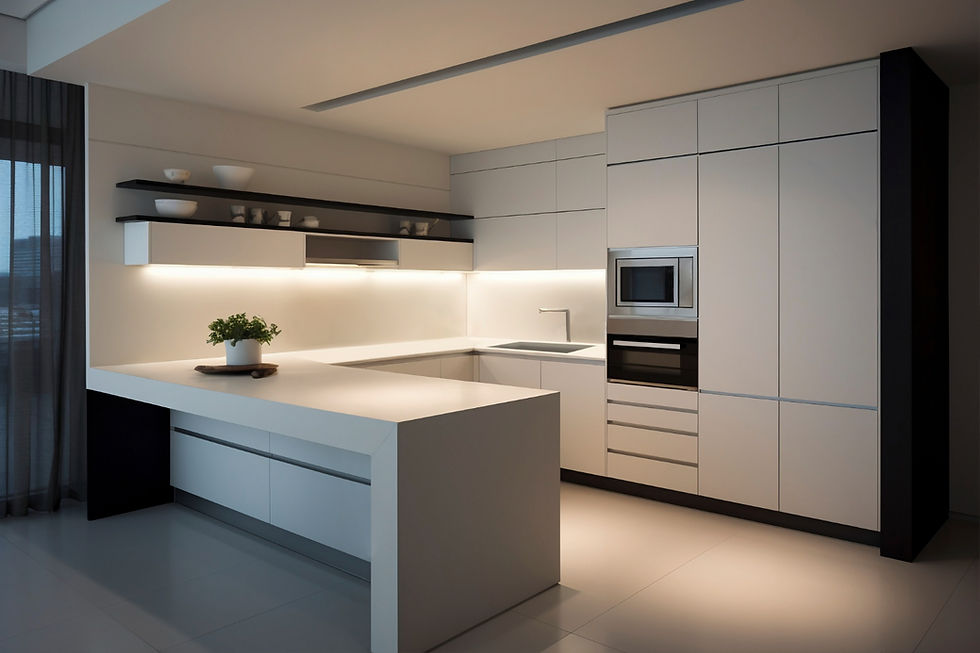
The right lighting approach for an L-shaped modular kitchen uses three layers: task lighting (under-cabinet LEDs directly illuminating the countertop), ambient lighting (recessed ceiling lights or a central pendant), and accent lighting (internal cabinet lights or a backlit splashback). Each layer serves a different function, and together they eliminate shadows and make the kitchen safe and pleasant to work in.
Recommended specifications:
Under-cabinet LEDs: 3000K–4000K, minimum 300 lux on countertop surface
Ceiling lights: recessed downlights at 600mm intervals
Avoid a single overhead light — it creates shadows directly above the cook
15. When Should You Add a Kitchen Island to an L-Shaped Layout?

A kitchen island makes sense in an L-shaped kitchen only when there is a minimum clearance of 900mm on all sides of the island — the standard recommended by the National Kitchen and Bath Association (NKBA). In Indian homes, this typically requires a kitchen area of at least 12×12 feet. A compact moveable island trolley (on lockable castors) can work in slightly smaller spaces and doubles as a breakfast counter.
Best island size for Indian kitchens: 900mm × 600mm for a 4-person household. Add a 150mm overhang on one side for seating.
16. What Are the Best Neutral Tones for a Timeless L-Shaped Kitchen?

The best neutral tones for a timeless L-shaped kitchen are warm grey (greige), linen white, soft taupe, and stone beige — shades that work with virtually any hardware finish (chrome, brass, matte black) and any flooring type. Neutral kitchens have the highest resale value appeal in the Indian property market and are the safest choice for homeowners who plan to resell within 5–7 years.
Unlike trendy colors that date quickly, a greige or warm white kitchen remains relevant across style cycles and only needs accessory updates (new handles, light fittings) to feel fresh.
17. Why Is a Corner Sink the Best Placement in an L-Shaped Kitchen?

Placing the sink in the corner of an L-shaped kitchen is considered the most ergonomically efficient placement because it sits naturally at the intersection of the two workflow zones — the prep zone and the cooking zone. This placement keeps the two countertop runs free for food preparation on both sides and reduces the distance between the sink, stove, and refrigerator (the kitchen work triangle).
Corner sink options: Single-bowl undermount stainless steel sink (most popular), corner composite granite sink, or a 45-degree angled sink cabinet that optimizes the corner angle.
18. What Is a Smart Storage Kitchen and What Accessories Make It Work?

A smart storage L-shaped kitchen uses every cubic inch of available space with engineered storage accessories rather than standard shelving. The key accessories that define a smart storage kitchen are carousel corner units (magic corners), tandem box drawers with cutlery organizers, pull-out pantry columns, wall-mounted pegboards, under-sink pull-out bins, and tall larder units.
Pro tip: The most underutilized zone in any L-shaped kitchen is the toe-kick area (the space beneath base cabinets). Install slim pull-out drawers in the toe-kick zone for baking trays, chopping boards, or newspapers.
19. How Do You Design an Eco-Friendly L-Shaped Modular Kitchen?

An eco-friendly L-shaped modular kitchen uses sustainable materials, energy-efficient appliances, and design strategies that reduce resource consumption. The most impactful choices are: BWR (Boiling Water Resistant) or marine-grade plywood certified from sustainably managed forests (FSC-certified), BEE 5-star rated appliances, low-VOC paints and adhesives, and LED lighting (which uses 70% less energy than fluorescent alternatives).
Maximizing natural light through a kitchen window not only reduces daytime electricity use but also improves ventilation — particularly important in Indian kitchens where cooking generates significant heat and moisture.
20. How Should a Vastu-Compliant L-Shaped Kitchen Be Designed?

A Vastu-compliant L-shaped kitchen should have the cooking stove positioned in the southeast zone of the kitchen (Agni corner), with the cook ideally facing east while cooking. The sink and water-related fixtures should be in the northeast quadrant. The refrigerator is best placed in the southwest corner, and the kitchen entrance should not be directly opposite the home's main door.
Additional Vastu guidelines for L-shaped kitchens:
Use yellow, orange, or red accents in the kitchen (fire-element colors)
Avoid black or blue as dominant colors (associated with the water element)
Ensure good cross-ventilation — a window in the east or north wall is ideal
The L-shape itself aligns well with Vastu as it naturally creates distinct zones for different elements
What Are the Key Advantages of an L-Shaped Modular Kitchen?
The L-shaped modular kitchen offers five core advantages over other layouts:
Efficient work triangle: The stove, sink, and refrigerator can be positioned at three points of a natural triangle, keeping total travel distance under 9 meters — the ergonomic benchmark for comfortable cooking.
Open-plan compatibility: Unlike U-shaped or galley kitchens, the L-shape leaves one or two sides open, making it easy to integrate with a dining or living area for social cooking.
Scalability: The layout works in spaces from 8×8 feet (compact apartments) to 14×12 feet (villa kitchens) with the same foundational design, only the scale changes.
Storage density: The two-wall configuration allows for both upper and lower cabinets on two runs, maximizing total storage volume compared to a straight kitchen.
Breakfast counter potential: One arm of the L can be extended or raised to create a seamless breakfast bar without requiring a separate room or floor space.
Frequently Asked Questions About L-Shaped Modular Kitchens
1. What is the best material for an L-shaped modular kitchen in India?
The best material for an L-shaped modular kitchen in India depends on budget and usage. For budget kitchens, laminate on HMR board is durable and cost-effective. For mid-range, acrylic on MDF offers a superior finish and is moisture-resistant. For premium kitchens, lacquered glass or membrane PVC shutters on BWR/marine plywood carcass offers the best longevity. For countertops, quartz is the most practical — harder than granite, non-porous, and available in 200+ finishes.
2. What is the minimum size for an L-shaped kitchen?
The minimum practical size for an L-shaped modular kitchen is 8×8 feet, though 10×10 feet is ideal. In a smaller space, opt for 450mm-deep countertops (instead of the standard 600mm) and avoid full-height upper cabinets, which can make the kitchen feel cramped.
3. How long does it take to install a modular L-shaped kitchen?
A standard L-shaped modular kitchen typically takes 4–6 weeks from order to installation — 2–3 weeks for manufacturing and 3–5 days for on-site installation. Kitchen preparation (waterproofing, electrical points, plumbing) should be completed before cabinet delivery.
4. What is the difference between a modular kitchen and a semi-modular kitchen?
A modular kitchen uses factory-made, standardized cabinet modules that are assembled on-site, offering precision, speed, and replaceable units. A semi-modular kitchen combines existing or site-built structures with modular accessories (drawers, shutters, hardware), making it a more economical upgrade option for renovation projects.
5. Can an L-shaped kitchen work in an open-plan Indian home?
Yes, an L-shaped kitchen is one of the best layouts for open-plan Indian homes. Positioning the longer arm of the L against the wall and extending the shorter arm into the room (as a breakfast bar or island transition) creates a natural visual boundary between the kitchen and living zone without requiring a wall partition.
Final Thoughts: Is an L-Shaped Modular Kitchen Right for You?
The L-shaped modular kitchen remains the gold standard for Indian homes in 2026 because it solves the three fundamental challenges of kitchen design simultaneously — space efficiency, workflow ergonomics, and aesthetic flexibility. Whether you are working with a compact 8×8 ft apartment kitchen or planning a generous 14×12 ft villa layout, the L-shape adapts without compromise.
The 20 design ideas in this guide cover the full spectrum of budgets, aesthetics, and lifestyle needs — from a ₹2.5 lakh laminate kitchen with smart storage accessories to a premium ₹8 lakh acrylic-and-quartz kitchen with an island and layered lighting. The right choice depends on your space, your cooking habits, and your long-term design vision.
If you are beginning your modular kitchen planning journey, start with three decisions: your ideal size, your countertop material, and your cabinet finish. Everything else — color, hardware, lighting, and accessories — flows naturally from those three foundational choices.


Comments