Home Office Design Ideas for Small Spaces: Work Smarter, Not Bigger

Quick Answer: Small home offices can be created without a separate room by using space-saving furniture, vertical storage, smart lighting, and clutter-control solutions. The best home office design ideas for small spaces include corner desks, wall-mounted storage, Murphy bed desks, fold-away workstations, and multi-functional furniture that keeps the workspace functional without taking over the room. |
Why Small Home Offices Need Smart Space Planning
Small home offices work best when every part of the space serves a purpose. Instead of trying to fit a traditional office into a limited room, focus on using unused corners, vertical space, multi-functional furniture, smart storage, and good lighting.
8 Home Office Design Ideas for Small Spaces
1. Claim a Corner and Own It Completely
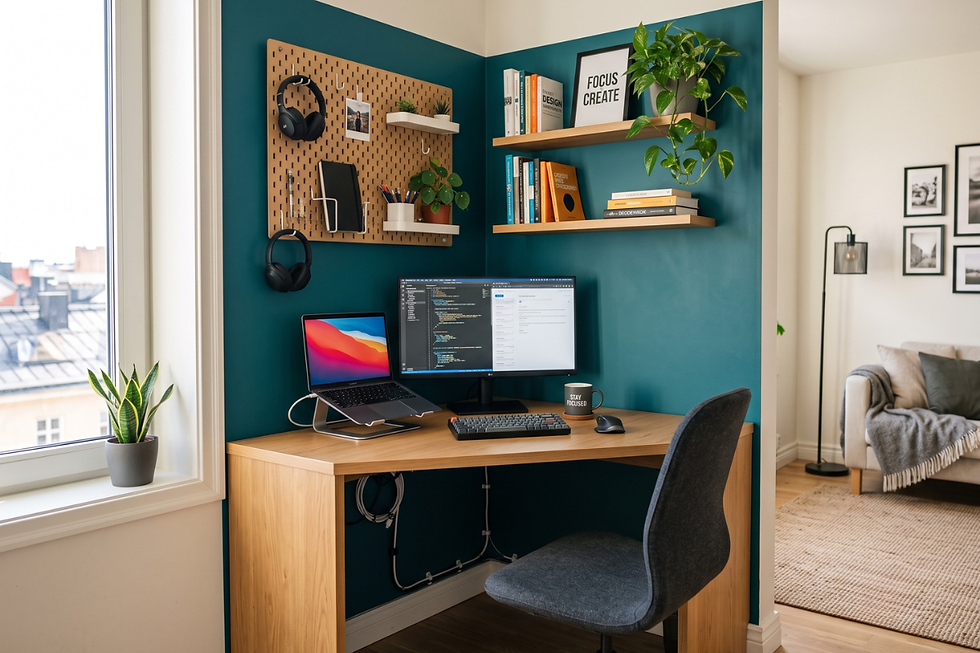
A corner desk is one of the easiest ways to create a dedicated workspace in a small home without taking up extra floor space.
The most underused space in any apartment is the corner. That awkward junction where two walls meet is often filled with a floor lamp or a plant that nobody waters. It is actually your ideal home office waiting to happen.
A corner desk, either an L-shaped unit or a simple triangular surface, fits flush against both walls and gives you significantly more workspace than a standard desk of the same footprint. Add a pegboard or floating shelves above it for storage, run your cables neatly down one wall, and suddenly you have a dedicated workspace that does not eat into your living area at all.
The psychological benefit is equally important. When your workspace has a clear physical boundary, even a corner, your brain begins to associate that zone with focus. You sit down, and you shift into work mode. You step away, and you genuinely switch off. That mental separation is priceless in a small home.
Design tip: Paint the corner wall in a slightly different shade from the rest of the room. A deep teal, a warm terracotta, or even a subtle sage green creates a visual frame that says "this is my workspace" without erecting a physical partition.
2. Go Vertical When the Floor Plan Says No

The easiest way to maximize storage in a small home office is to use vertical wall space instead of adding more floor-standing furniture.
In a small space, the floor is your most precious real estate. The moment you stop treating walls as decoration and start treating them as storage, everything changes.
Floating shelves mounted above your desk keep books, files, stationery, and equipment at arm's reach without consuming any floor space. A wall-mounted monitor arm frees up your entire desk surface. A pegboard system lets you hang everything from headphones to scissors to a small corkboard for notes and references.
Floor-to-ceiling shelving units on one wall create the feeling of a proper study even in a studio apartment, and they can also help soften sound in the room.
Design tip: Use matching storage boxes or baskets on open shelves to keep the visual feel clean and cohesive. A wall of mismatched clutter defeats the purpose entirely.
3. The Murphy Bed Desk: Your Apartment's Best Kept Secret

A Murphy bed desk is a practical space-saving solution for a studio apartment or one-BHK because it combines a workspace and sleeping area in one piece of furniture.
If you work from a one-BHK or a studio and truly cannot spare a corner, it is time to meet the Murphy bed desk, also called a wall bed with an integrated workspace. By day, the unit sits flush against the wall as a desk with shelving. By night, the panel folds down to reveal a full bed.
This is not necessarily a compromise solution. Modern Murphy bed desk units are designed to combine functionality with space efficiency and can be customized by furniture makers and modular interior brands in India. They can be particularly useful in compact apartments where every square foot needs to serve more than one purpose.
Design tip: When choosing a Murphy bed desk, look for one with a secure locking mechanism and adequate cable management so your laptop, notebooks, and other desk items can be safely managed when the bed is folded down.
4. Borrow Space from the Living Room, Invisibly

You can integrate a home office into the living room by using slim, fold-away, or concealed furniture that blends with the existing interior.
Not every home office needs to announce itself. In a small apartment, one of the most elegant solutions is to integrate your workspace into the living room so seamlessly that it disappears when you are not using it.
A slim console table placed against the wall doubles as a desk. A closed cabinet unit with a fold-out surface hides your entire office inside it, and when the doors close, the living room returns to its relaxed, domestic self. A bookshelf with one closed section can conceal a monitor, printer, and filing system behind a simple door.
The goal is a workspace that is present and functional during working hours, and virtually invisible during leisure time. In a small home, this kind of design intelligence is worth far more than any trendy piece of furniture.
Design tip: Match your workspace furniture to the existing living room palette. If your sofas are in warm neutrals and your shelving is in a natural wood tone, extend the same palette to your workspace unit, so it reads as part of the room, not an intrusion into it.
5. Light Like You Mean It

The best lighting for a small home office combines natural light, ambient lighting, and task lighting to create a comfortable and functional workspace.
Lighting is the single most underestimated element of home office design, and it matters even more in a small space. Poor lighting can make a workspace feel uncomfortable and can make video calls less flattering.
Every small home office benefits from three types of light working together. Ambient light provides the base layer of illumination for the room. Task lighting, such as a good adjustable desk lamp, delivers focused brightness directly where you are working. And natural light, as much as you can get of it, is valuable during the day.
If your workspace is near a window, position your desk parallel to it rather than facing it to reduce screen glare. Natural light from the side can also work well for video calls.
For evenings, warm-white LED bulbs around 3,000–4,000 Kelvin can provide a balance between visibility and comfort. Choose the colour temperature based on your preference and the overall lighting in the room.
Design tip: A soft backlight behind your monitor can make the screen area feel more comfortable during long work sessions and is an inexpensive upgrade for a small home office.
6. Manage the Chaos: Cable and Clutter Control

The easiest way to reduce clutter in a small home office is to organize cables, paperwork, and everyday accessories so that everything has a designated place.
Nothing shrinks a small space faster than visible clutter. And nothing creates clutter more reliably than a working desk with cables snaking in every direction, papers multiplying, and coffee cups accumulating.
Cable management is not glamorous, but it is transformative. Cable trays mounted under the desk, cable clips along the wall, and a simple cable box to hide the power strip behind the desk can immediately make the space look more organized.
For papers and files, a single deep drawer or a small filing cabinet on wheels that can be pushed under the desk when not in use is useful. The rule is simple: everything needs a home. If an object does not have a designated place, it will always end up on your desk surface.
Design tip: Go wireless wherever possible. A wireless keyboard, mouse, and charger can help reduce visible cable clutter at the source.
7. Acoustics: The Problem Nobody Talks About

You can improve acoustics in a small home office by adding soft furnishings such as rugs, curtains, upholstered furniture, bookshelves, and acoustic panels to reduce echoes and unwanted sound reflections.
You can have the most beautiful small home office in the world, but if you are conducting client calls from a room that echoes, or if every sound from the kitchen seeps directly into your headphones, none of it matters.
In small spaces, hard surfaces such as tiled floors, bare walls, and glass windows can create a reflective acoustic environment. A few simple additions can make the room feel more comfortable for calls. A large area rug under your desk can soften floor reflections. Curtains or fabric blinds can help soften the room, while bookshelves filled with books and upholstered furniture can add more soft surfaces.
If you are doing a lot of video calls from a home office, a dedicated acoustic panel on the wall behind your monitor can also be considered. Fabric-finished panels can function as both a practical and decorative element.
Design tip: Use large-leafed plants such as monstera or rubber plants as part of the overall room design. They add warmth and visual interest, although they should complement—not replace—proper acoustic treatments.
8. Make It Yours: Personalisation That Fuels Productivity

The best way to personalize a small home office is to choose a few meaningful items that make the workspace feel comfortable without adding unnecessary clutter.
A workspace that feels sterile and impersonal may not feel inviting. In a small space, personalisation does not mean adding more stuff. It means being intentional about what you do include.
A framed print that genuinely moves you. A small plant that you actually enjoy caring for. A mug that makes the morning coffee ritual feel like a small luxury. A desk mat in a colour that makes you happy to sit down.
These are small things, but they can make the difference between a space you simply tolerate and a space that feels like it belongs to you and supports your daily routine.
Design tip: Keep personalisation minimal but meaningful. Choose one or two items—such as a framed print, small plant, decorative desk mat, or favourite mug—that add personality without making the workspace feel crowded.
Best Small Home Office Solutions at a Glance
Home Office Solution | Best For | Main Benefit |
Corner desk | Unused corners | Maximizes workspace |
Floating shelves | Small rooms | Saves floor space |
Murphy bed desk | Studio/1-BHK homes | Combines work and sleeping space |
Fold-out desk | Living rooms | Can be hidden when not in use |
Wall-mounted monitor | Compact desks | Frees up desk space |
Cable management | Any small office | Reduces visual clutter |
Small Home Office Design Ideas for Indian Apartments
Small apartments and compact homes in Indian cities often require workspaces that serve multiple purposes. In cities such as Bengaluru, Mumbai, Delhi-NCR, and Hyderabad, homeowners can make better use of limited space with corner desks, vertical storage, fold-away furniture and living-room workstations. The right solution depends on the room layout, available natural light, storage requirements, and whether the workspace needs to be hidden after working hours.
How to Choose a Home Office Design for a Small Space
Measure the available space before choosing furniture.
Identify unused areas, such as corners or wall space.
Choose multi-functional furniture where possible.
Use vertical storage to reduce floor clutter.
Prioritize lighting and ergonomics for comfortable work.
Plan cable and document storage before setting up your desk.
Consider acoustics if you frequently attend video calls.
Quick Reference – Best Home Office Ideas for Small Spaces
Very small room: Fold-out or wall-mounted desk
Unused corner: Corner/L-shaped desk
Studio apartment: Murphy bed desk
Limited storage: Floating shelves + pegboard
Shared living room: Fold-away workstation
Video-call heavy work: Acoustic panels + good lighting
Cluttered workspace: Cable management + closed storage
Whether you’re working with a compact apartment, a shared living room, or a small corner, the right interior design can make your home office feel both functional and inviting. At Ideas & Living, we help you make the most of your available space with thoughtful interior solutions tailored to your home, lifestyle, and needs.
From space-saving furniture and smart storage to complete home interiors, our design approach focuses on creating spaces that look good and work well every day.
Looking to make better use of your space? Explore Ideas & Living for practical, personalized home interior solutions.
Frequently Asked Questions (FAQs)
Q1. How do I set up a home office in a very small apartment with no extra room?
The best approach in a truly compact apartment is to use multi-functional furniture and vertical space. A Murphy bed desk unit gives you a full workspace by day and a bed by night without sacrificing either. A fold-out desk built into a closed cabinet hides the office entirely when not in use. A corner desk maximises a typically wasted zone.
The key principle is that a home office does not need its own room; it needs a clearly defined zone, good lighting, and enough storage to keep clutter off the desk surface.
Q2. What is the ideal desk size for a small home office?
For a compact home office, a desk between 100 and 120 centimetres wide and 50 to 60 centimetres deep is sufficient for most work setups, including a monitor, laptop, and basic desk accessories.
If you are using a wall-mounted monitor arm, you can go with an even shallower desk surface of 45 centimetres since the monitor does not occupy desk depth. Avoid going smaller than 100 centimetres wide unless space is genuinely critical, as a too-small desk surface creates a cramped, uncomfortable working experience.
Q3. How do I reduce noise and distractions in a small home office?
Layering soft materials is the most effective approach. A large rug under the desk, fabric curtains on windows, bookshelves lined with books, and upholstered seating all absorb ambient sound. For calls, a good pair of noise-cancelling headphones is a worthwhile investment.
If your home is particularly noisy, an acoustic panel on the wall facing the camera makes a significant difference to both your focus and your audio quality on video calls. Plants, particularly large-leafed varieties, also help absorb sound while adding visual warmth.
Q4. What colour should I paint my small home office to improve focus?
Colour psychology research suggests that soft blues and blue-greens promote calm focus, making them popular choices for home office walls. Sage green and warm olive tones are grounding and reduce eye fatigue during long work sessions.
If you need creative energy, a warm terracotta or a deep mustard accent wall behind the desk adds stimulation without overwhelm. Avoid very bright whites as the sole wall colour in a small space, as they can feel clinical and actually increase glare on your screen. Warm off-whites and light naturals are a better neutral base.
Q5. How do I make my home office look professional for video calls?
Three elements determine how professional your video call background looks: lighting, background, and audio. For lighting, position a desk lamp or a ring light facing you so your face is clearly and warmly illuminated.
For background, keep the area behind you tidy and consider a simple feature wall (a framed print, a neat bookshelf, or a plant) that looks intentional rather than accidental. For audio, use a headset or earphones with a built-in microphone rather than your laptop's internal mic.
These three upgrades, which cost very little, make a dramatic difference to how you present on calls.


Comments